Adam Markowicz, a doctoral student in bioengineering, has been awarded a research grant from the German Academic Exchange Service (DAAD) through its Binationally Supervised Doctoral Degrees / Cotutelle program.
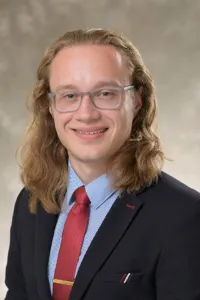
The program supports exceptional doctoral researchers whose work is strengthened by sustained collaboration between leading research institutions in two countries. The award will enable Markowicz to earn a binationally supervised PhD in partnership with the University of Lübeck, Germany. It provides a monthly stipend of €1,400 along with research support and travel allowances, enabling 7–24 months of flexible research visits throughout the course of the doctoral program.
At the heart of Markowicz’s project is the development of advanced medical imaging technology designed to improve the safety and precision of brain surgery. His research centers on optical coherence tomography (OCT), a non‑invasive imaging technique that uses light to create highly detailed images of tissue in real time. Often described as the optical analogue of ultrasound, OCT can reveal microscopic structures that are otherwise invisible during surgery without disrupting the surgical workflow.
The DAAD grant will facilitate close cooperation between two research groups with distinct but highly complementary strengths. At Illinois, Markowicz is supervised by Prof. Stephen Boppart, whose group specializes in extracting functional biological information from OCT images and translating imaging technologies into clinical practice. In Germany, Markowicz will work with Prof. Robert Huber at the University of Lübeck, whose laboratory is internationally known for developing ultrafast Fourier-Domain Mode-Locked (FDML) lasers that enable exceptionally rapid imaging during surgery.
“I am very excited to work with the leader of FDML laser development and ultrafast OCT imaging,” says Markowicz. “Working closely with both research groups will allow me to have the technical and clinic support required to translate OCT into the operating room.”
By combining ultrafast imaging hardware developed in Germany with advanced image analysis and clinical translation expertise at Illinois, the collaboration aims to create an imaging system that can be seamlessly integrated into a surgical microscope. This system would allow surgeons to visualize brain tissue in three dimensions during an operation—helping them distinguish tumor tissue from healthy tissue and better protect critical neural structures in real time.
Beyond its technical innovation, the project exemplifies the broader mission of the DAAD program: fostering long‑term international research partnerships. Over the course of his doctoral training, Markowicz will complete multiple extended research stays in Germany, contributing to joint publications and establishing a durable transatlantic collaboration.
“Programs like DAAD’s are essential for preparing the next generation of researchers,” said Dana Johnson, director of external fellowships. “By investing in long-term, deeply integrated international collaborations, DAAD enables graduate students to work at the highest levels of their fields while building the global partnerships that drive scientific innovation forward.”
See our Fellowship Finder database for more information about DAAD’s Binationally Supervised Doctoral Degrees / Cotutelle Program, Doctoral Research Grants, and Graduate Research Internships in Science and Engineering.