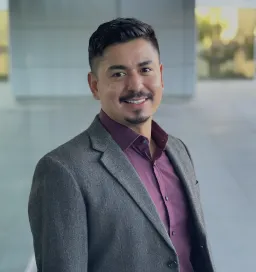
Gerson Morales Pérez (Spanish and Portuguese) is a 2026–27 HRI Graduate Fellow. His current research project, “From Erasure to Memory: Cultural Representations of War, Indigeneity and Resistance in Contemporary Guatemala,” examines how contemporary cultural production (such as art, performance, and literature) critically approaches the ongoing erasure of Indigenous histories and the unresolved legacies of the Guatemalan civil war.
Learn more about HRI’s Campus Fellowship Program, which supports a cohort of faculty and graduate students through a year of dedicated research and writing in a collaborative, interdisciplinary environment.
What is unique about your research on this topic?
My research looks at how artists and writers respond to histories of violence that are at risk of being forgotten or erased. My dissertation focuses on Guatemala and the lasting effects of the country’s civil war (1960–1996), particularly the violence experienced by Indigenous Maya communities. I study performance, visual art, and literature to understand how these forms engage with histories of violence and their lasting effects.
One of the main questions guiding my research is: What can art, performance, and literature help us understand about histories of violence beyond what we learn from historical documentation? Legal proceedings, testimonies, state records, and other forms of documentation are essential for establishing what happened and seeking accountability. I am interested in the ways artists and writers preserve memories of the violence, but also how they connect that history to the present. This is especially important to my project because the effects of the war did not simply end with the signing of the Peace Accords in 1996. Questions of Indigeneity, displacement, migration, and historical memory continue to shape Guatemala and the lives of Guatemalans beyond its borders.
What drives your interest in this research?
My interest in this project is both intellectual and personal. I am from Guatemala, but much of what I now know about the Guatemalan Civil War I have learned through my own research. This experience makes me think about what it means to come from a place whose recent history is seldom discussed nationally and internationally, and about the larger processes that determine what gets remembered, what gets taught, and what gets left out.
As I began encountering artists and writers who were confronting this history in their work, I became interested in the different ways they make the past visible. What continues to interest me is that they are not simply documenting something that happened decades ago. Their work shows how the past continues to shape the present and raises questions about whose memories become part of a nation’s history and whose remain marginalized or erased.
How has the fellowship seminar shaped the way you’re approaching your research?
I was the first fellow to present my work to the seminar, and that experience was especially valuable because it allowed me to hear how scholars from different fields respond to the questions at the center of my project. Their feedback helped me recognize that many of the questions I am asking about memory, erasure, and the lasting effects of violence resonate beyond my own field and the specific context of Guatemala. The conversation also encouraged me to return to some of my central questions with a different perspective. The seminar has helped me think more deeply about the broader stakes and about the possibilities contained in questions I was already asking.
This article was reposted from the Humanities Research Institute website.